AF-S Micro Nikkor 60mm F2.8G ED Arrival
Back to Notes on Photography
by Makoto Honda
April 7, 2008 / Revised April 01, 2016
A new
Nikon macro lens that I ordered from Adorama arrived today
(4/1). The official name of this lens is a long alphabet soup:
AF-S Micro Nikkor 60mm F2.8G ED. The AF means auto-focus, S means it has
a silent motor in it for fast and quiet auto-focusing.
The G designation is for the lens lacking a mechanical aperture ring.
The ED means the lens contains a lens element made of “extra-low
dispersion” glass. This lens has a 9-leaf
diaphragm. Along with the “rounded” blades,
the opening of the lens aperture maintains a fairly good circular shape
for the first few stops. This macro lens also focuses to the
magnification of 1:1 without needing any extension ring. The lens size,
however, is huge compared with my good old Ai
Micro Nikkor 55mm F2.8 lens.
I personally do not like a lens that does not have the traditional aperture ring, but many new lenses are designed as G lenses. I do not know why this lens has to be this huge. Also, why does it have to take a large 62mm filter size when the front element of the lens is much small er. I have some extra 52mm filters but I have to buy 62mm filters for this lens. On my second thought I may consider using a step-down ring (62-->52), which should not compromise any light collecting capability of this lens.
Also, this is an FX lens, meaning its image circle covers the full 35mm format. So I can use this for D3 series cameras if I get one. This lens can be also used for 35mm film cameras, but unfortunately, I do not have any 35mm film Nikon cameras that support the CPU connection. For DX format cameras such as a Nikon D300, the adjusted focal length is 90mm.
I just tried only a few shots using my D300, but I have every reason to believe this is a very useful lens for me. The lens has an excellent MTF chart (provided by Nikon). That is the main reason I decided to get this lens.
Some Observations:
LCD display of effective F-aperture
This lens has F2.8 - 32 apertures. In the Manual or Aperture-priority mode (using D300/D200), I set the lens to F2.8 (wide-open), but as I turn the focusing ring from infinity to the closest setting, the aperture display on the camera LCD changes from F2.8 to F4.8. Also, at the closest, I can set the aperture to F54. Initially I thought this lens is showing the "effective" F-aperture – and I was right. Nikon does display the effective F-aperture on the LCD. But then, if I set the aperture to F5.6 to start with, the displayed F-aperture never changes as I turn the focusing ring all the way to the closest. This behavior puzzled me.
The closest focus for this lens gives 1:1 magnification, so there is a 2-stop compensation factor. That means if you set your lens to F2.8, your effective F-aperture is F5.6. Similarly, your F5.6 will become the effective F-aperture of F11.
So how do we explain the above behavior of this 60mm F2.8 Nikkor lens?
This lens has a so-called internal focusing (IF). This means the lens does not lengthen as you focus on a close-up subject. (The total lens length remains unchanged.) They tweak the positioning of lens elements to achieve focusing. In so doing, the focal length of the lens is changed also! That is, the 60mm focal length is not maintained throughout its focusing range. This is a bit of a "zoom" lens in effect – even if I did not order a zoom lens; I bought a fixed focal length lens of 60mm! This change of the focal length of the lens when you focus the lens from infinity to the closest is affectionately known as a “focus breathing” problem. Yes, this is a problem. You’ve been had!
Many lenses, cheap and expensive, do have this focus breathing issue of varying intensity.
Focus breathing (change of focal length internally)
As it turned out, in the case of an AF-S Micro Nikkor 60mm F2.8G ED lens, the focal length gets shorter (to around 50mm) as you focus near 1:1 magnification. As a consequence, the lens gets a bit brighter, to around F2.4. Since the 1:1 close-up imposes the exposure factor of 2 stops (see photomacrography), the camera's LCD display correctly shows the effective F-aperture of F4.8 (2 stops from F2.4) when the lens is set wide-open (as I did above).
So we solved the first puzzle. But how about the second one? How come the initial F5.6 setting does not change on the LCD display when I move to the closest focus. Aren’t they supposed to show the effective F-aperture?
Yes, they are showing the effective F-aperture. This display of F5.6 is the effective aperture, not the F5.6 I had set. But wait. The effective F-aperture should be F11 since my original setting was F5.6… Well, this is what happened. Nikon, in its infinite wisdom, tries to maintain your initial request of F5.6. In close-up, it’s no longer F.5.6 but rather F11, so the lens kindly opens the physical aperture by 2 stops (to F2.8) so that you can maintain the effective aperture of F5.6. Let me repeat, the lens was opened to F2.8 setting transparently without your knowing it. The F2.8, by the way, is not “wide-open” but close. Remember, you are using a 50mm F2.4 lens, not 60mm F2.8.
Change of aperture (internally)
Many photomacrographers would not appreciate this. Nikon may argue that the aperture was opened accordingly to compensate for the exposure factor imposed so as to maintain the same shutter speed..... Hold it! I am doing this test using my D300 in Manual or Aperture-priority mode, not Shutter-priority mode!
Coming back to the AF-S Micro Nikkor 60mm lens, I noticed the aperture transition chart in the user's manual. This chart tells us how the LCD display of the aperture changes according to the focus setting of the lens. The manual does state the LCD displays the effective aperture.
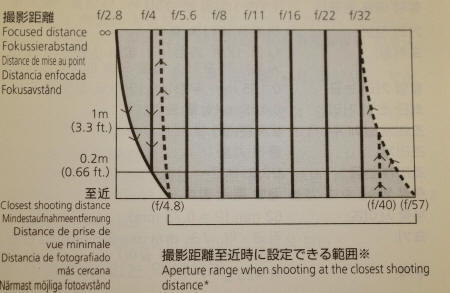
What we are talking about here is a complex subject, but we made it more confusing by mixing two issues together. So I will try to separate them.
1) LCD aperture display - Nikon's LCD display is the effective aperture. This is a Nikon's design decision. This has a true value. If this was all Nikon is doing, I would not have any complain (maybe a little). This means, at 1:1 magnification, the display should show F4.8 if the lens is wide-open. This is indeed what I see. By the same token, if the lens is set at F5.6 at infinity, I should see F11 on the display. However, what I see is F5.6. See 2) below. Before I leave here, let me say that the effective aperture display is useful, but I am also interested in knowing the actual aperture, so that I can easily see how many stops it is from wide-open. Guessing that from the effective aperture display is difficult. An obvious solution is to show both (as an option). Actually, I am more interested in seeing the exposure factor (the number of stops), rather than the actual effective aperture value.
2) Changing the aperture - In Shutter-priority and Program-mode, the lens aperture is changed automatically. So the concept of auto-adjusting the aperture is nothing new. But when your camera changes the lens aperture when you are focusing, you may feel uncomfortable. I do. This physical aperture change is effected by the macrophotography exposure factor. This is an intentional design on the part of Nikon. Some people may like it. I do see some benefit of this kind of behavior, but this should be an option for the user. I will turn it off.
The current Nikon implementation transparently opens the lens aperture by 2 stops (at 1:1) until wide-open is reached (and cannot physically open any more). .
Focus Breathing
In the case of AF-S DX VR Zoom Nikkor ED 18-200mm F3.5-5.6G (another lens I own), the lens epithet tells you that the lens aperture gets F5.6 toward the 200mm telephoto end. What they don’t tell you is that the focal length also changes as you focus. This is what I mean: Suppose I am using this lens at 200mm. I focus on a subject, say, 20 feet away. I expect my lens to be 200mm, because that’s how it is being set. Comparing with my fixed focal length Nikkor 180mm, I have noticed that the view angle of my 18-200mm (set at 200mm) is barely that of 180mm – more like 150mm. (I felt a little bit cheated.) I can get the exact 200mm focal length only when the lens focus is close to infinity.
| Carnivorous Plants Photography Web Site: Copyright © 2001-2018 Makoto Honda. All Rights Reserved. |